Film Guides / Watching smarter
Film glossary
Over 70 film, filmmaking and cinema terms explained in one plain-English line each, from anamorphic and auteur to wide release and zoom.
Film talk has its own vocabulary. Each term below gets a short, plain-English definition, with a link to the full guide where we have one.
73 terms
A
- Above the line
- Costs for key creative people such as writers, directors, producers and lead actors, set before filming starts.
- Academy ratio
- The roughly 1.37:1 frame shape standardized for sound films in 1932. See aspect ratios.
- ADR
- Automated dialogue replacement: actors re-record lines in a studio after filming. See sound.
- Anamorphic
- A lens that squeezes a wide image onto a standard frame, unsqueezed when projected.
- Aspect ratio
- The width of the picture divided by its height.
- Auteur
- A director seen as the main creative author of a film, with a recognizable personal style.
B
- Below the line
- Costs for the crew, equipment, sets and other production expenses.
- Best boy
- The chief assistant to the gaffer or key grip.
- Blockbuster
- A big-budget film designed for very wide audiences. See the blockbuster era.
- Blocking
- Planning where actors move and stand in a scene.
- Box office
- Money earned from ticket sales. See how the box office works.
- B-roll
- Supplementary footage cut into a film or documentary between main shots.
C
- Call sheet
- The daily schedule telling cast and crew when and where to report.
- Cameo
- A brief appearance by a well-known person.
- Cinematographer
- The head of the camera and lighting departments, also called the director of photography or DP.
- Close-up
- A shot showing a face or object in detail.
- Color grading
- Adjusting the color and contrast of footage after filming. See color grading.
- Continuity
- Keeping details consistent between shots, such as props, costumes and positions.
- Coverage
- All the shots filmed of a scene from different angles, giving the editor choices.
- Crane shot
- A shot from a camera on a crane, often rising or sweeping.
- Cut
- An instant change from one shot to the next.
D
- Dailies
- The raw footage from a day's shooting, reviewed by the director and team.
- DCP
- Digital Cinema Package: the set of files used to project a film digitally in cinemas.
- Deep focus
- Keeping both near and far parts of the frame sharp at once.
- Depth of field
- How much of the image, from front to back, is in focus.
- Diegetic sound
- Sound that exists in the story world, such as dialogue or a radio playing.
- Director's cut
- A version of a film edited to the director's preference.
- Dissolve
- A transition where one shot fades into the next.
- Dolly
- A wheeled platform for moving the camera smoothly.
- Dutch angle
- A tilted camera angle that suggests unease.
E
- Establishing shot
- A wide shot that shows where a scene takes place.
- Extra
- A background performer without lines.
F
- Fade
- A transition to or from black or another color.
- Final cut
- The right to decide the final version of a film.
- Foley
- Recreating everyday sounds such as footsteps in a studio, in sync with the picture.
- Frame rate
- The number of images shown per second. See frame rates.
G
- Gaffer
- The chief lighting technician. See lighting.
- Green screen
- A colored backdrop replaced with other imagery in post-production.
- Grip
- A crew member who builds and moves camera support and rigging.
H
- High frame rate (HFR)
- Projection above the standard 24 frames per second, such as 48 or 120.
I
- IMAX
- A large-format film and projection system. See IMAX.
J
- Jump cut
- An abrupt cut within the same shot that makes time appear to jump.
K
- Key light
- The main light illuminating a subject.
L
- Letterbox
- Black bars above and below a widescreen image on a narrower screen.
- Long take
- A single shot that runs for a long time without a cut.
M
- MacGuffin
- An object or goal that drives the plot but matters little in itself.
- Matte painting
- A painted background combined with live action footage.
- Mise-en-scene
- Everything placed in the frame: sets, actors, props, costumes and lighting.
- Montage
- A sequence of short shots that compresses time or builds an idea.
- Motion capture
- Recording an actor's movements to animate a digital character.
N
- Non-diegetic sound
- Sound outside the story world, such as the musical score.
P
- Pan
- Turning the camera horizontally from a fixed position.
- Post-production
- Everything after filming: editing, sound, effects, music and grading.
- Practical effect
- An effect created physically on set rather than digitally.
- Premiere
- The first public screening of a film.
- Pre-production
- Planning before filming: casting, locations, design and scheduling. See pre-production.
R
- Rough cut
- An early assembled version of the edit.
S
- Score
- The original music written for a film. See film scoring.
- Screenplay
- The script, with dialogue and descriptions of action.
- Second unit
- A smaller crew that films stunts, inserts and scenery away from the main unit.
- Shot reverse shot
- Alternating shots of two characters during a conversation.
- Slate
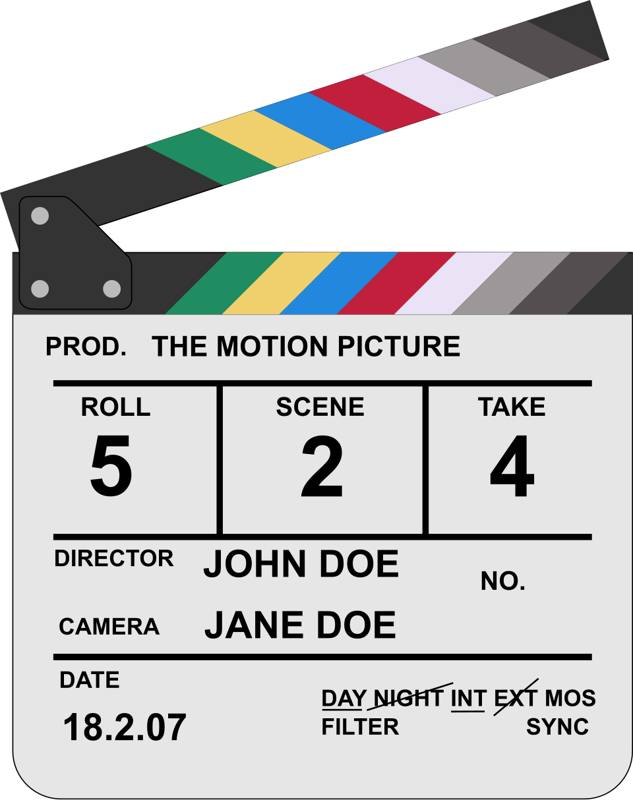
- The clapperboard used to label takes and sync sound.
- Steadicam
- A body-worn stabilizer for smooth handheld camera movement.
- Storyboard
- Drawings that plan a film shot by shot.
T
- Take
- One recorded attempt at a shot.
- Theatrical window
- The period a film plays only in cinemas before home release.
- Tracking shot
- A shot where the camera moves alongside the action.
- Treatment
- A prose summary of a film's story, written before the screenplay.
V
- VFX
- Visual effects, usually created digitally. See visual effects.
- Voice-over
- Narration heard over the images.
W
- Wide release
- A film opening in a large number of cinemas at once.
- Wrap
- The end of filming for a day or for the whole production.
Z
- Zoom
- Changing the focal length of a lens during a shot to move closer or farther.