Film Guides / How movies are made
Sound for film
Production sound, ADR, Foley, sound effects and the final mix: how every sound in a movie is recorded, rebuilt and balanced.
Many filmmakers say sound is half the experience. Audiences forgive a slightly soft image far more readily than muffled dialogue. Most of what you hear in a finished film was not recorded at the moment the camera rolled. It was built, layer by layer, in post-production.
Production sound
On set, the production sound mixer records dialogue, and the boom operator holds a directional microphone on a long pole just outside the frame. Actors may also wear small wireless lavalier microphones hidden in their costumes. The goal is clean dialogue with as little background noise as possible.
The crew helps by asking for silence, switching off fridges and air conditioning and recording room tone: a minute of the location's natural quiet that editors later use to fill gaps.
The clapperboard exists because of sound. On film shoots, picture and sound are recorded separately; the visible clap and the audible snap give editors a single frame to line them up. See editing.
ADR
When dialogue recorded on set is unusable, perhaps because of wind, traffic or a noisy effect, actors re-record it later in a studio while watching the scene. This is ADR (automated dialogue replacement), also called looping or dubbing. Good ADR is matched so closely to the original performance and acoustics that audiences never notice it. Dubbing into other languages uses the same basic process.
Foley
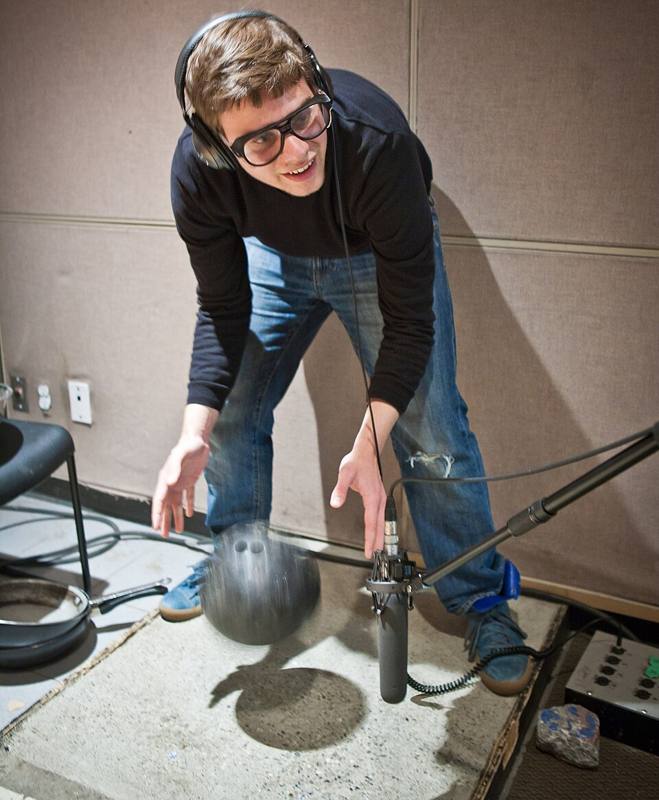
Foley artists perform everyday sounds in sync with the picture: footsteps, clothing rustle, a cup set on a table, a door handle. The craft is named after Jack Foley, who worked on sound at Universal in the early sound era. A Foley stage has pits with different surfaces (gravel, wood, tile, sand) and a large collection of props. Many movie sounds come from surprising sources, such as celery snapped for breaking bones or leather gloves flapped for bird wings.
Sound effects and design
Sound effects editors add everything else: cars, crowds, weather, machines. Sound designers create sounds that do not exist in real life, like an alien creature or a futuristic engine, often by layering and processing recordings of real animals, machines and instruments.
The layers of a soundtrack
| Layer | What it contains | Who handles it |
|---|---|---|
| Dialogue | Production sound plus ADR | Dialogue editors |
| Foley | Footsteps, clothes, props | Foley artists and mixer |
| Effects | Hard effects and backgrounds | Sound effects editors |
| Design | Invented or stylized sounds | Sound designers |
| Music | Score and licensed songs | Composer and music editor, see film scoring |
Keeping these layers separate also lets distributors replace the dialogue for foreign-language versions while keeping effects and music. The version without dialogue is known as the M&E (music and effects) track.
The final mix
On a mixing stage that resembles a small cinema, re-recording mixers balance all layers so dialogue stays clear, music swells at the right time and effects hit hard without drowning the story. They also place sounds around the room. A mix for 5.1 or 7.1 surround uses fixed channels; an object-based format such as Dolby Atmos lets mixers place sounds in three-dimensional space, including overhead.
A brief history
Feature films were silent, with live music in cinemas, until synchronized sound took over in the late 1920s. Read the story in the talkies. Multichannel sound in cinemas became common in the 1970s, and digital cinema sound formats arrived in the early 1990s.
Try watching a familiar scene with your eyes closed. You will notice how much of the story the sound tells on its own.