Film Guides / How movies are made
Film editing
Editing is where a film is truly written for the last time. Learn the stages of the edit, the classic cuts and the machines editors have used.
A film is written three times: in the script, on set and in the edit. The editor watches every take, selects the best moments and arranges them so the story flows, the pacing works and the emotion lands. A single scene can be cut in dozens of different ways.
From film to digital
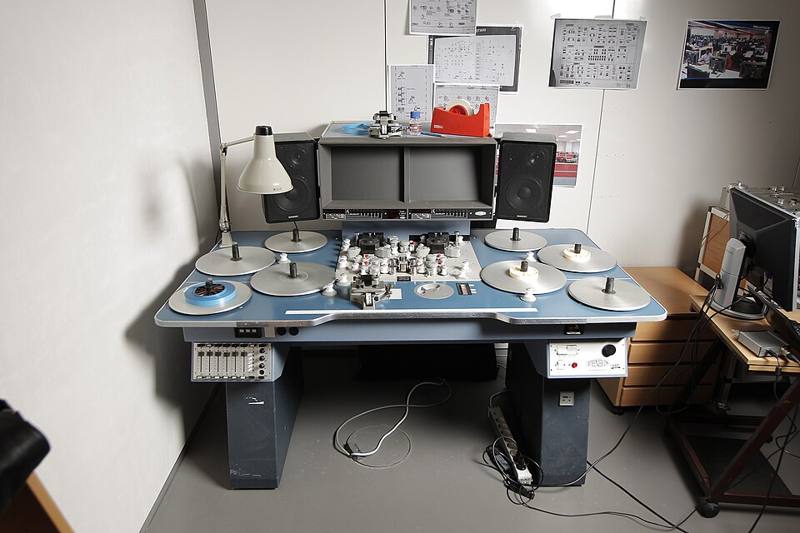
For most of film history editors physically cut and taped strips of film. The upright Moviola, introduced in the 1920s, let an editor view footage through a small viewer. From the 1960s flatbed tables such as the Steenbeck and KEM became common, especially in Europe; they could play picture and sound together on a larger screen.
From the early 1990s, non-linear editing on computers took over. Footage is digitized or recorded digitally, and editors can rearrange shots instantly without touching the original material. Today almost every film and series is cut this way.
The stages of an edit
- Dailies: footage from each shooting day is reviewed, often the next day.
- Assembly: the editor puts every scene together in script order, usually long and rough.
- Editor's cut: the editor's own refined version.
- Director's cut: the director works with the editor, often for at least ten weeks under traditional guild rules in the US.
- Producer's or studio cut: input from producers and test screenings.
- Picture lock: the edit is final. Sound, visual effects, color grading and music all finish against this locked version.
The language of cuts
| Technique | What it does | Feeling |
|---|---|---|
| Continuity cut | Joins shots so action appears seamless | Invisible, immersive |
| Match cut | Links two shots by shape, movement or sound | Clever transitions across time or place |
| Jump cut | Cuts within the same shot, skipping time | Jarring, energetic, modern |
| Cross-cutting | Alternates between two scenes happening at once | Suspense, rising tension |
| Montage | A sequence of short shots compressing time | Training, travel, growing love or success |
| Cutaway | Briefly shows something else in the scene | Reaction, detail, humor |
| L-cut and J-cut | Sound leads or trails the picture | Natural conversation flow |
| Dissolve and fade | One image blends into another or to black | Passing time, endings |
Continuity editing rules, such as the 180-degree rule that keeps two characters on consistent sides of the screen, developed in the silent era and still guide most mainstream films. The French New Wave made breaking them, especially with jump cuts, a style of its own.
The Kuleshov effect
In the early 1920s Soviet filmmaker Lev Kuleshov is reported to have cut the same neutral close-up of an actor against different images. Audiences read different emotions into the identical face. Whatever the exact details of the original experiment, the principle is central to editing: meaning comes from how shots are combined, not only from the shots themselves.
Pace and rhythm
Editors control the speed of a film. Average shot lengths in mainstream cinema have shortened over the decades. Action scenes may cut every second or two, while dramas hold shots longer to let performances breathe. Good editors also cut on movement, use sound to smooth transitions, and remove anything the story does not need, even beautiful shots.
Editors often say the best edits are the ones nobody notices. Audiences simply feel the film is "well paced".
Working with sound
The editor builds a temporary soundtrack, sometimes with temporary music, to make screenings feel finished. After picture lock, the sound team replaces and refines everything.