Film Guides / How movies are made
Cameras and lenses
From hand-cranked film cameras to large-sensor digital cinema cameras, and why the lens matters as much as the camera body.
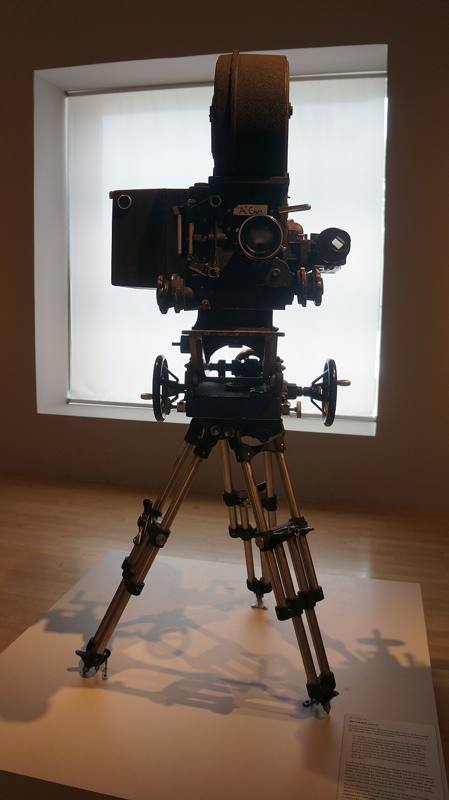
The camera records the image, but the lens shapes it. Cinematographers often say they choose lenses first and cameras second, because the lens decides how wide the view is, how much is in focus and the character of every highlight.
A short history of the movie camera
Early cameras such as the Lumiere Cinematographe of 1895 were hand-cranked; the operator turned a handle at a steady pace. Electric motors took over as sound arrived in the late 1920s, because sound needed a constant speed (see frame rates). Sound also forced cameras to become quiet. Heavy soundproof housings called blimps were followed by self-blimped studio cameras such as the Mitchell BNC.
From the 1960s onward lighter cameras made handheld shooting practical, which helped movements like the French New Wave. In the 2000s and 2010s digital cinema cameras replaced film on most productions, although some filmmakers still choose 35mm and 65mm film.
Film versus digital
| Film camera | Digital cinema camera | |
|---|---|---|
| Records to | Photochemical film negative | Sensor, saved to memory cards or drives |
| Typical formats | 16mm, 35mm, 65mm | Super 35-sized and large-format sensors |
| See results | After the lab develops the film | Instantly on set |
| Running cost | Film stock and processing per minute shot | Storage and data management |
| Look | Organic grain, smooth highlight roll-off | Clean image, very flexible in color grading |
Modern digital sensors are often described by their size. "Super 35" sensors are about the size of a 35mm film frame. "Large format" or "full frame" sensors are bigger, which produces a shallower depth of field at the same framing.
Focal length in plain English
Focal length, measured in millimeters, describes how wide or narrow a lens sees.
- Wide lenses (about 14 to 24mm): show a lot of the scene, exaggerate depth and make spaces feel big.
- Normal lenses (about 32 to 50mm on Super 35): close to how we perceive a scene.
- Long or telephoto lenses (75mm and up): compress distance, flatten backgrounds and isolate faces.
Prime lenses have one fixed focal length and are generally sharper and faster. Zoom lenses cover a range and save time on set. Many features are shot mostly on primes.
Aperture and depth of field
Cinema lenses use T-stops rather than the f-stops of still photography. A T-stop is a measured value of how much light actually passes through the lens, so a T2 lens delivers the same exposure as any other T2 lens. A wide aperture such as T1.5 lets in a lot of light and gives a shallow depth of field, where only a thin slice of the scene is sharp. The focus puller's job is to keep that slice on the actor.
Spherical and anamorphic lenses
Most lenses are spherical. Anamorphic lenses squeeze a wide image horizontally onto the sensor or film, and the image is stretched back in projection or post-production. They are linked with the classic 2.39:1 widescreen frame (see aspect ratios and widescreen) and have a recognizable look: oval out-of-focus highlights and horizontal lens flares.
Camera support and movement
How the camera moves is part of the storytelling:
- Tripod: steady, observational frames.
- Dolly and track: smooth moves toward, away from or alongside actors.
- Crane or jib: rising and falling moves.
- Handheld: energy, urgency, documentary feel.
- Stabilizers such as the Steadicam, introduced in the mid-1970s: smooth moving shots without track.
- Drones: aerial shots that once needed helicopters.
On your next watch, pick one scene and ask: wide or long lens? Moving or still camera? You will start to see how much of the mood comes from these choices.