Technicolor and the arrival of color
Films were colored by hand, stencil and dye long before Technicolor's famous three-strip camera. Here is how movie color evolved from painted frames to digital grading.
Many people assume that every old movie was black and white. In fact, color appeared on screen almost immediately, and a large share of silent films were shown with some form of color. What took decades was natural, photographic color that could be printed cheaply in large numbers. Technicolor became the most famous name in that story.
Color before color film
Early filmmakers added color after shooting:
- Hand coloring. Workers painted individual frames with tiny brushes. Georges Melies sold hand-colored prints of some of his films.
- Stencil coloring. Companies such as Pathe cut stencils to apply colors to areas of each frame more consistently.
- Tinting. The whole film strip was dyed, so a night scene might be blue and a fire scene red.
- Toning. A chemical process colored only the dark parts of the image.
The first successful photographic process was Kinemacolor, introduced in Britain in 1908. It filmed and projected alternating red and green frames, which blended into color on screen, but it needed special projectors and produced color fringes on moving objects.
The Technicolor company
Technicolor was founded in 1915 by Herbert Kalmus, Daniel Comstock and W. Burton Wescott. The "Tech" in the name refers to the Massachusetts Institute of Technology, where Kalmus and Comstock had studied. The company spent nearly two decades improving its system:
| Process | Era | How it worked | Limitation |
|---|---|---|---|
| Process 1 | 1917 | Two colors combined in the projector | Needed special projection |
| Processes 2 and 3 | 1920s | Two-color (red and green) prints made by combining dyed layers | Could not show true blue or yellow well |
| Process 4, three-strip | 1932 onward | A prism split light onto three black-and-white negatives behind red, green and blue filters | Huge, heavy camera and very bright lighting needed |
| Single-strip era | 1950s onward | Shot on one color negative, often printed by Technicolor | Colors depended on film stock and lab |
How the three-strip camera worked
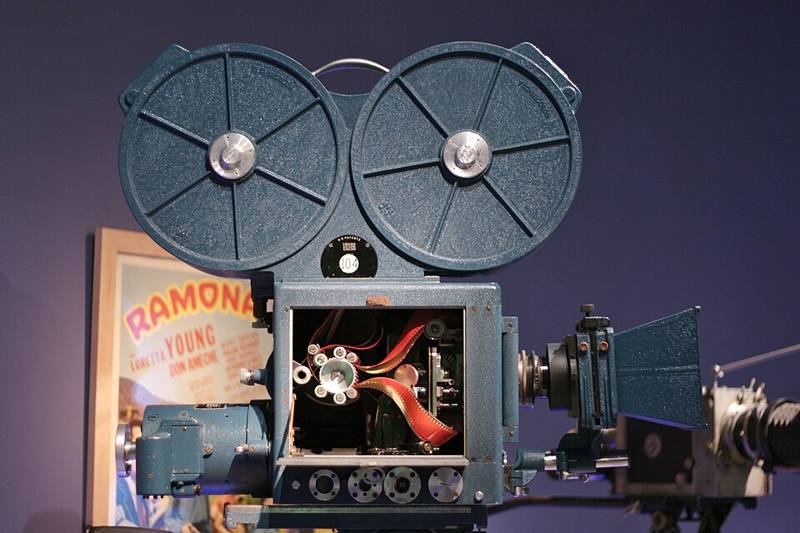
Inside the three-strip camera, light from the lens hit a beam-splitter prism. Part of the light went to one film strip behind a green filter; the rest went to two strips running together that recorded red and blue. The result was three black-and-white negatives, each holding one color record.
To make prints, Technicolor used a dye transfer (imbibition) process. Each record became a printing matrix that soaked up dye, and the three dyes were transferred one by one onto blank film, almost like printing a magazine. Dye transfer prints are famous for rich, stable colors that do not fade the way many later color films did.
The system had real costs. The cameras were large and heavy and had to be rented from Technicolor along with its operators. The film needed a great deal of light, which made sets hot. Productions also worked with Technicolor's color consultants, led for many years by Natalie Kalmus, who advised on costumes, sets and makeup.
Landmark Technicolor films
- Flowers and Trees (1932). A Walt Disney animated short and the first commercial film released in three-strip Technicolor. It won the first Academy Award for an animated short.
- Becky Sharp (1935). Usually cited as the first live-action feature made entirely in three-strip Technicolor.
- The Wizard of Oz (1939). Famous for its switch from sepia-toned Kansas to a world of saturated color.
- Gone with the Wind (1939). One of the most successful films of its era, shot in Technicolor.
The single-strip revolution
In 1950 Eastman Kodak introduced Eastmancolor, a color negative film that worked in ordinary cameras. It was much cheaper and easier to use. By the mid-1950s, the three-strip camera was retired, though Technicolor continued to process and print films. Its famous dye-transfer printing was discontinued in the United States in the 1970s.
Color also became a key tool in the competition with television, which was mostly black and white at the time. Along with widescreen, it gave audiences a reason to go out to the cinema.
From the lab to the grading suite
For most of the 20th century, color was controlled chemically in the lab through "color timing." In 2000, O Brother, Where Art Thou? became one of the first features to be scanned and color-corrected digitally for its entire running time, using what is called a digital intermediate. Today almost every film is finished this way. Learn how in our guide to color grading.
Black-and-white did not disappear when color became cheap. Filmmakers still choose it for mood or style, and some modern films are released in both color and black-and-white versions.